
Electromagnetic Field Enhancement
Fabrication of Robust and Scalable SERS Substrates
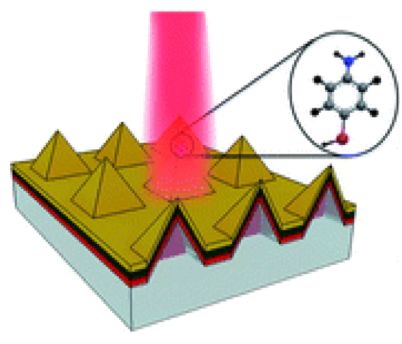
The combination of soft lithography and wet chemical techniques has enabled the fabrication of chemically robust and mechanically flexible surface enhanced Raman scattering (SERS) substrates.

The prepared flexible substrates exhibit significantly strong SERS signals to facilitate 4-aminobenzenethiol (4-ABT) detection, boasting large SERS enhancement factors of 10⁸ orders of magnitude. More importantly, the engineered “hot spots” are uniformly distributed in a large-scale area with consistent SERS enhancements. The top right images exhibit the typical SERS spectra and mapping results of 4-ABT molecules adsorbed on the designed substrate.
Plasmonic Photoelectrochemical Enhancement

The enhanced near-fields from plasmonic Au nanoparticles can be used to amplify the optical transition rate within a nearby semiconductor (Cu2O nanowire) and enhance the light-harvesting efficiency of photoelectrochemical cells.

Incident photon-to-charge conversion efficiency (IPCE) of a control device (Cu2O-only, red) and plasmonic device (Cu2O/Au@SiO2, blue) showing enhanced photoelectrochemical performance from 500-600 nm in the plasmonic device as a result of the Au@SiO2 nanoparticles.