
The Wei Research Group
discovering novel electronic and optical properties of metallic and semiconductor nanomaterials
Energy – Nanomaterials – Environment
Research Focus
Our research focuses on three areas: the synthesis of novel plasmonically active hybrid nanomaterials, their fundamental properties, and the applications of these materials in areas such as solar energy conversion, photocatalysis, bioimaging, and displays, as well as analytes detection.


Research Motivations
- The size and shape dependent optical properties of plasmonic nanomaterials provide unique opportunities for enhanced utilization of light to control photochemical reactions and modulate material properties by optical excitation.
- The enhanced electric field that results from optical excitation leads to increased signals in certain analytical methods and more efficient plasmonically enhanced charge transport.

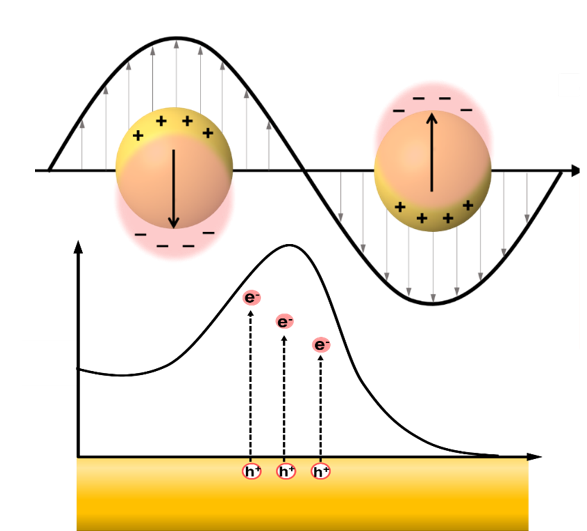
Optically Induced Oscillation of Free Electrons
- Signature optical property of metallic nanoparticles (e.g. Au, Ag, Cu)
- Incident light of an appropriate frequency
- Induces a coherent oscillation of conduction electrons on the nanoparticle surface
- Collective oscillation produces a locally-enhanced electromagnetic (EM) field near the nanoparticle surface, which can exceed incident excitation intensity by many orders of magnitude, concentrating EM energy at the nanoscale.
Acknowledgements

The goal of the Wei Research Team is to develop a vibrant and productive research program focusing on discovering novel electronic and optical properties of metallic and semiconductor nanomaterials and their implications for electronics, photonics, energy, and biomedicine.
A fundamental understanding of the structure-dependent localized optical properties of nanostructures with sub-10 nm resolution will lead to comprehensive knowledge of the surface plasmon-directed growth of novel anisotropic nanostructures, and design rules for the synthesis and fabrication of hybrid nanostructures with optimized properties for solar energy harvesting, conversion and storage, photocatalysis, and chemical and biological detection. All these projects are highly diverse and interdisciplinary in nature that combine analytical chemistry, physical chemistry, inorganic chemistry and materials science and engineering.